Erasmus+ 2028–2034: What the New Regulation Tells Us About the Future of European Education and Skills
- Mehmet Altay
- Jun 24
- 3 min read

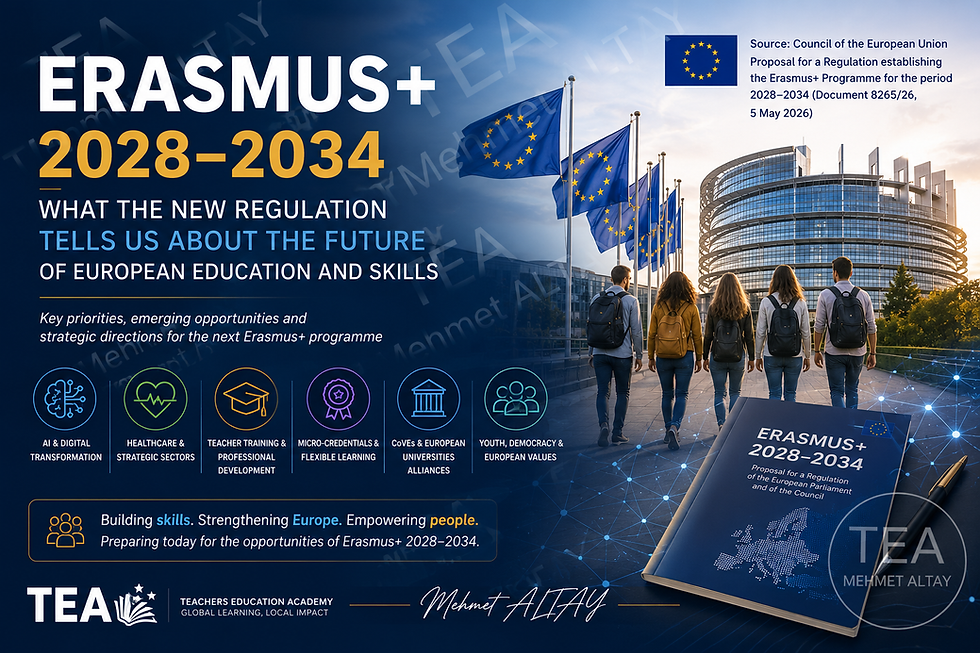
In May 2026, the Council of the European Union published a compromise text on the proposed Regulation establishing the Erasmus+ Programme for the period 2028–2034.
While the legislative process is still ongoing, the document already provides valuable insight into the strategic direction of the next generation of Erasmus+.
After carefully reviewing the proposal, several trends emerge that every educational institution, vocational provider, university, NGO, and project developer should start preparing for today.
1. Erasmus+ Is No Longer Just About Mobility
Mobility remains at the heart of the programme, but the new proposal clearly positions Erasmus+ as a strategic instrument supporting:
The Union of Skills
European competitiveness
Talent development
Labour market resilience
Skills shortages in strategic sectors
The focus is shifting from simply funding exchanges towards strengthening Europe's long-term economic and social capacity.
For project developers, this means that demonstrating a clear connection between learning activities and future workforce needs will become increasingly important.
2. Artificial Intelligence Moves to the Centre of European Education Policy
One of the most significant messages in the proposal is the emphasis on digital transformation and Artificial Intelligence.
The document explicitly highlights:
Digital readiness
Digital capacity building
Media literacy
Critical thinking
AI-related transformation of education and training systems
This confirms what many educators have already observed: AI is no longer an emerging topic. It is becoming a core component of European educational policy.
Institutions investing in AI literacy, teacher training, ethical AI use, and digital innovation are positioning themselves strongly for the next Erasmus+ cycle.
3. Healthcare Becomes a Strategic Priority
The proposed Regulation identifies several strategic sectors that are essential for Europe's future.
Among them:
Healthcare
Digital technologies
Energy
Water resilience
Agriculture
Aerospace
Defence
The explicit recognition of healthcare is particularly noteworthy.
For vocational education providers, universities, and training organisations, this creates significant opportunities for projects related to healthcare innovation, workforce development, simulation technologies, and digital health solutions.
4. Centres of Vocational Excellence (CoVEs) Are Here to Stay
A particularly encouraging element for the VET sector is the continued support for Centres of Vocational Excellence.
The proposal strengthens their role as drivers of:
Innovation
Skills development
Labour market responsiveness
Regional economic growth
Rather than being reduced, CoVEs appear to be becoming an even more important instrument within the European skills agenda.
For organisations already engaged in CoVE initiatives, this is a strong signal to continue investing in long-term partnerships and sectoral excellence.
5. European Teacher Academies Continue to Gain Importance
The proposal confirms continued support for:
European Teacher Academies
European Universities Alliances
European School Alliances
Centres of Vocational Excellence
Teacher professional development remains a key European priority.
This presents a significant opportunity for organisations specialising in teacher training, digital pedagogy, inclusive education, and innovative teaching methodologies.
6. Micro-Credentials Will Become Mainstream
The Regulation repeatedly refers to flexible learning pathways and micro-credentials.
Europe is clearly moving toward a more modular and lifelong learning-oriented education system.
This development creates new possibilities for:
Short specialised courses
Stackable qualifications
Professional upskilling programmes
Industry-responsive learning pathways
Training providers that adapt early will have a considerable advantage.
7. Youth, Democracy and European Values Remain Fundamental
Despite the stronger focus on skills and competitiveness, Erasmus+ does not abandon its traditional values.
The proposal reinforces support for:
Democratic participation
Civic engagement
Inclusion
Solidarity
European values
Youth participation
This balance between economic competitiveness and social cohesion is likely to remain one of the defining characteristics of the future Erasmus+ programme.
What Should Organisations Do Now?
Based on the current proposal, organisations should already begin strengthening their capacity in:
✓ Artificial Intelligence and Digital Education
✓ Healthcare and Health-Related Skills Development
✓ Centres of Vocational Excellence
✓ Teacher Training and Professional Development
✓ Micro-Credentials and Lifelong Learning
✓ Youth Participation and Democratic Engagement
The final Regulation may still evolve during negotiations, but the strategic direction is already visible.
The message from Brussels is clear:
The future Erasmus+ programme will continue to promote mobility and inclusion, but it will also become a powerful instrument for building Europe's skills, talent, resilience, and competitiveness.
Those who begin adapting today will be best positioned to benefit from the opportunities of Erasmus+ 2028–2034.
Source: Council of the European Union, Proposal for a Regulation establishing the Erasmus+ Programme for the period 2028–2034 (Document 8265/26, 5 May 2026).
#ErasmusPlus #Erasmus2028 #EuropeanEducation #VET #SkillsUnion #ArtificialIntelligence #TeacherTraining #VocationalEducation #HealthcareEducation #MicroCredentials #CoVE #EuropeanProjects #LifelongLearning #EducationInnovation #TeachersEducationAcademy


Comments